

The Hidden Hero of Vinyl: Why Your Phono Stage Shapes the Sound of the Best Turntables in Australia
There is a moment in every great vinyl session when the room seems to settle. The stylus touches down, the first notes emerge, and suddenly your living room feels less like a house and more like a private concert hall.
We’ve all been there. You invest in a beautiful turntable, connect it to your amplifier, and expect that rich, warm, analogue soul. Instead, the sound is quiet, thin or strangely bright.
The culprit is often not the turntable.
It is the phono stage.
This small component is the invisible backbone of a vinyl system. It takes the exceptionally delicate signal generated by your cartridge, amplifies it to a usable level and applies the correct equalisation before passing it to your amplifier.
In other words, your search for the best turntables Australia has to offer should not stop at the deck itself. The phono stage can determine how much of that turntable’s potential you actually hear.
Why vinyl needs a dedicated phono stage
A phono cartridge does not produce a conventional line-level signal like a CD player, streamer or television. As the stylus traces the microscopic modulations in a record groove, the cartridge generates only a few millivolts of electrical output.
A typical moving-magnet cartridge may produce around 3–6 mV. A low-output moving-coil cartridge can produce as little as 0.2–0.5 mV.
Your amplifier’s regular line inputs, such as AUX, CD or Network, expect a signal hundreds of times stronger.
There is another layer of complexity. Records are cut using the RIAA equalisation curve. Bass frequencies are reduced and treble is boosted during cutting to make the groove physically manageable and minimise noise. The phono stage reverses that process, restoring the tonal balance intended by the recording engineer.
A quality phono stage therefore performs two essential jobs:
- Gain: It lifts the cartridge’s tiny signal to line level.
- RIAA equalisation: It restores the correct balance between bass, midrange and treble.
Without those functions, a turntable connected to a standard line input will sound extremely quiet and tonally incorrect.
The phono stage is not an accessory. It is the foundation between the groove and the rest of your system.
Moving magnet versus moving coil
The first matching decision is understanding your cartridge type.
Moving magnet cartridges
With a moving-magnet, or MM, cartridge, a small magnet attached to the stylus moves within fixed coils. MM cartridges generally produce a higher output and are compatible with the majority of integrated amplifiers with a phono input.
They are also practical. Replacement styli are widely available, and cartridge upgrades are typically straightforward.
The Music Hall Classic semi-automatic turntable is a good example. Priced at $1,099 at Toma Audio, it includes a factory-mounted Music Hall Spirit MM cartridge and a switchable built-in phono preamplifier. That makes it a flexible starting point for a serious vinyl system.
You can use its internal phono stage initially, then bypass it later when you add a dedicated external model.
Moving coil cartridges
Moving-coil, or MC, cartridges work differently. The coils move within a fixed magnetic field. Their lower moving mass can deliver excellent detail, speed and delicacy, but low-output MC designs generate a much smaller signal.
That means they require more gain and often more precise electrical loading. Loading refers to the resistance and capacitance presented to the cartridge by the phono stage. If the match is incorrect, the system may sound too subdued, too sharp or lacking in dynamics.
This is where a sophisticated phono stage becomes a genuine sound investment rather than simply another box in the rack.
Why a built-in phono input is often only the beginning
A built-in phono input is useful. It is convenient, cost-effective and often perfectly suitable for a first system.
The Marantz PM6007, for example, includes a built-in MM phono stage, alongside its integrated amplification and digital connectivity. Its phono input is designed around a conventional MM cartridge, making it an appealing choice for an accessible two-channel system.
But convenience and ultimate performance are not the same thing.
In many integrated amplifiers, the built-in phono stage is designed to meet a price point and serve a broad range of listeners. It may offer limited gain, fixed loading and no support for low-output MC cartridges. It also shares space and power-supply resources with the amplifier’s other circuits.
As your turntable, cartridge and speakers improve, these limitations can become audible.
You may notice:
- A flatter or smaller soundstage.
- Less separation between instruments.
- Background hum or hiss.
- Reduced bass authority.
- A presentation that feels less open and emotionally engaging.
That does not mean a built-in phono input is poor. It means it may be the starting point of your vinyl journey rather than the final destination.
The Primare R35: an upgrade with room to grow
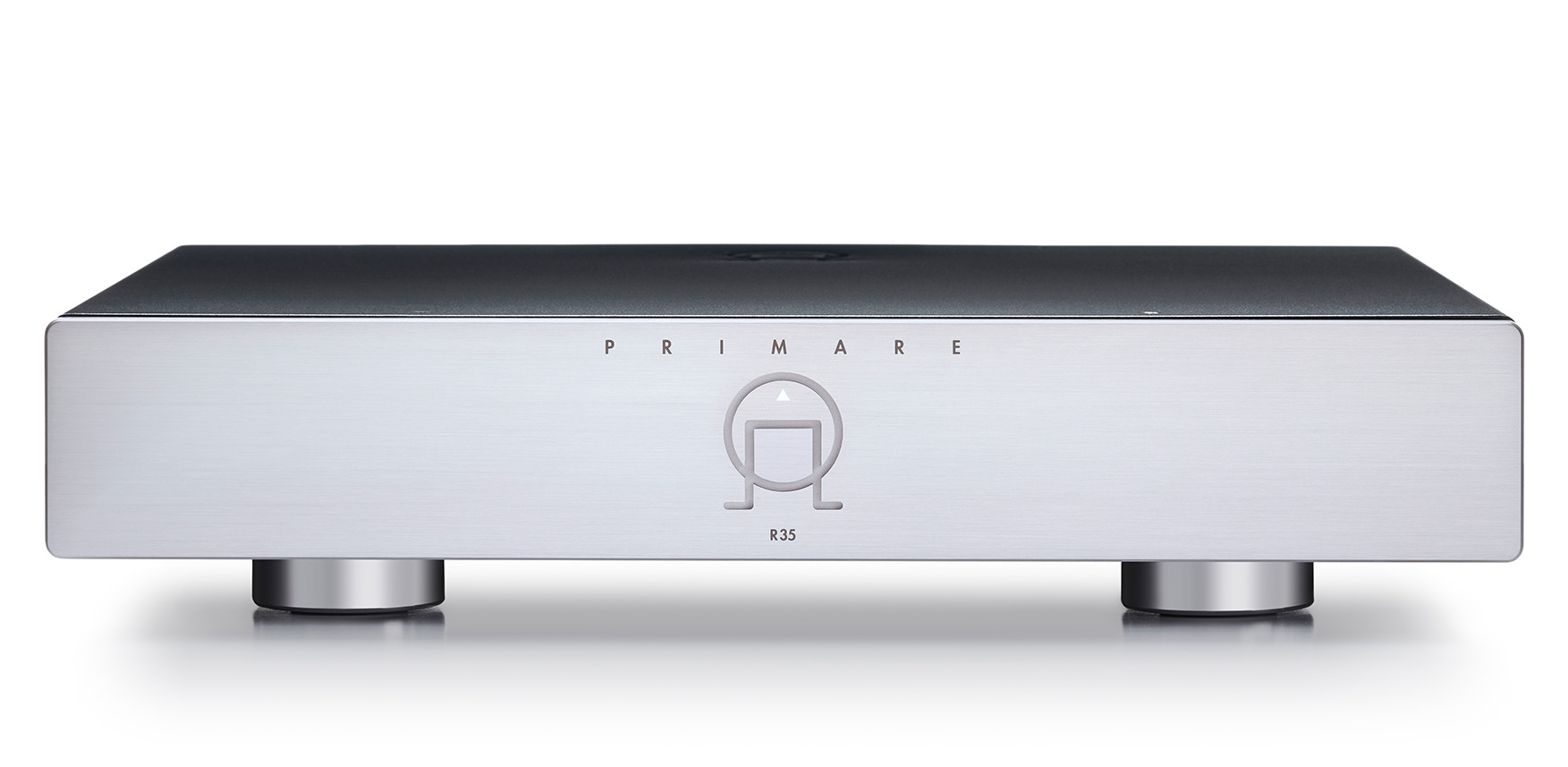
At Toma Audio, the Primare R35 is available at $2,999. It is designed specifically to sit between your cartridge and amplifier, giving the phono signal the dedicated attention it deserves.
The R35 supports both MM and MC cartridges, with adjustable gain and a broad range of resistance and capacitance settings. In plain English, it can be configured to suit a wide variety of cartridges rather than forcing every cartridge into the same electrical environment.
Primare specifies gain up to 50 dB for MM and 76 dB for MC. It also provides both RCA and balanced XLR outputs, making it suitable for systems ranging from a refined integrated amplifier to a more ambitious preamplifier and power amplifier arrangement.
That flexibility matters if you follow the buy once, buy well philosophy.
You might begin with the Music Hall Classic and its supplied MM cartridge. Later, you may upgrade the cartridge, move to a more revealing turntable or build a larger system around Primare electronics. The R35 can remain the phono foundation through those changes.
It is the audio equivalent of installing a solid copper backbone in a home. Everything connected to it benefits from the stability and capacity underneath.
Matching the phono stage to your amplifier
The phono stage must match not only the cartridge, but also the amplifier it feeds.
Toma Audio can help you explore several pathways, including:
- Primare I15 Prisma: A compact, highly capable integrated amplifier for listeners who value elegant design, network playback and a clean two-channel system.
- Primare I25 Prisma: A more substantial modular integrated amplifier with greater power and system-building flexibility.
- Primare I35 Prisma: A high-performance option for larger rooms, demanding speakers and listeners who want a serious long-term foundation.
- Onkyo A-50: An integrated amplifier with a switchable MM/MC phono stage, useful when you want one amplifier to accommodate different cartridge types.
- Onkyo P-80: A versatile preamplifier with switchable MM/MC phono capability, suited to a more ambitious separates-based system.
- Marantz PM6007: A straightforward MM-based solution for an accessible, musical system.

The right choice depends on more than wattage. Your listening room, speaker sensitivity, preferred volume, cartridge output and future upgrade plans all matter.
A highly sensitive speaker such as a Klipsch Heritage model may reveal the difference between a quiet, refined phono stage and one that introduces audible noise. A more modest bookshelf speaker may benefit from a warmer, forgiving pairing.
There is no universal winner. There is only the right integration for your room and your music.
A simple phono-stage matching checklist
Before choosing a phono stage, consider these five questions:
-
Is your cartridge MM or MC?
Never assume that every phono input supports both. -
What is the cartridge output?
Low-output MC cartridges need substantially more gain than MM designs. -
Can the phono stage adjust loading?
Adjustable resistance and capacitance provide more precise cartridge matching. -
Are you bypassing a built-in phono preamp?
If your turntable includes one, switch it off before connecting to a dedicated external phono stage. -
Will the system grow?
If you plan to upgrade your cartridge or amplifier, a flexible phono stage may be the more economical long-term decision.
The final question is the most important: does the combination sound emotionally convincing to you?
Hear the difference in the Toma Audio showroom
Specifications are useful. Listening is decisive.
At Toma Audio, we believe in personalised advice, careful system matching and sound investments that continue to reward you over time. Our showroom in Tweed Heads gives you the opportunity to audition turntables, phono stages, integrated amplifiers and speakers in a relaxed setting.
You might hear the Music Hall Classic through a Marantz PM6007. You might compare an amplifier’s built-in phono stage with the Primare R35. Or you might explore a Primare Prisma system driving Klipsch Heritage speakers and discover how much scale, texture and presence your records have been waiting to reveal.

The aim is not to sell you the most expensive component. It is to create a balanced, bespoke system that suits your home, your collection and the way you actually listen.
That might mean unwinding with a glass of red and a well-loved album. It might mean rediscovering the atmosphere of a symphonic masterpiece. Either way, the phono stage is working quietly beneath the experience.
Visit Toma Audio at 119 Wharf Street, Tweed Heads, or contact our team to arrange an audition.
You are welcome to bring your favourite record. We’ll listen first.